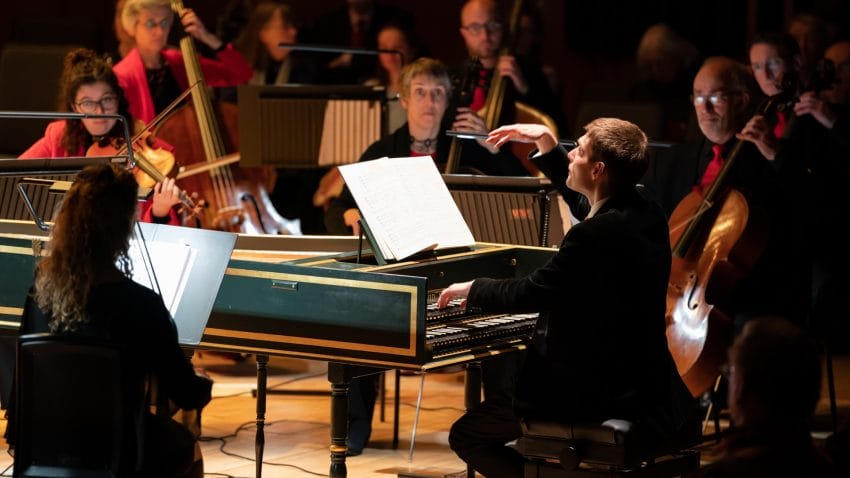
Harpsichord extraordinaire Thomas Allery talks us through the almost cinematic storytelling in St John Passion.
The St John Passion is a retelling of the biblical story of the crucifixion. How do you approach interpreting music with a narrative?
The challenge with such a large narrative like this is how to create a long narrative arc which spans the whole piece, so I guess the pacing is very important. In the case of the St John Passion, I always try to internalise who the chorus addresses at any given point: in the opening chorus, and in the chorales we are speaking to Jesus on behalf of everyone (or in the case of original performances, the chorales were sung by the congregation) and sometimes the chorus acts as the crowd. The arias serve a meditative function as we dwell on an emotion, feeling, or moment in the story for slightly longer, depicted by one musician, and with Bach’s orchestration then allowing instruments to have a more vocal colour in response. And the evangelist’s telling of the story feels quite fast and driven in comparison. So, for me, the trick is to allow each dramatic effect to work for the overall narrative. The drama and heightened emotion never stops, it just changes pace: sometimes we dwell on a feeling and our breath slows, sometimes the scenes change much more quickly – like in stunning film making!
Sometimes we dwell on a feeling and our breath slows, sometimes the scenes change much more quickly – like in stunning film making!
Outside of music, what inspires your artistry?
As an organist, I am always inspired by architecture and buildings, and of course, the design of religious buildings (in which I spend a lot of my time!) always tell stories. Aside from that, I love the beauty of the outdoors and I find that noticing the changing seasons with their different lights and plants give me a lot of my energy.
Tell me about how you approach interpreting Bach, and does it differ from other composers?
To be honest, I try not to treat composers particularly differently as I feel that my job is to bring the music alive in a way which is relevant to the present setting with the original context inspiring my decisions and improvisation. In the case of Bach, his writing seems to tell us what to do – in the recits, his harmony is rich and leads the story on from the bass, and in the chorales, every line seems perfectly formed to allow the singers to shape the phrase naturally. Bach’s voice is so unique and distinctive that I try to allow that to guide me. Then it’s about context and taking inspiration from why the piece was written, and what it originally sought to do. Thinking of the piece is a religious devotion, or a religious meditation allows you to take it to some different places. Some of the moments are quite private where it feels like the speaker is speaking to Jesus alone, sometimes, it feels like we speak to him as a community.
Here are some other bits we think you'll like
The Hitchhiker's Guide to Bach Chorales
Messiah 360