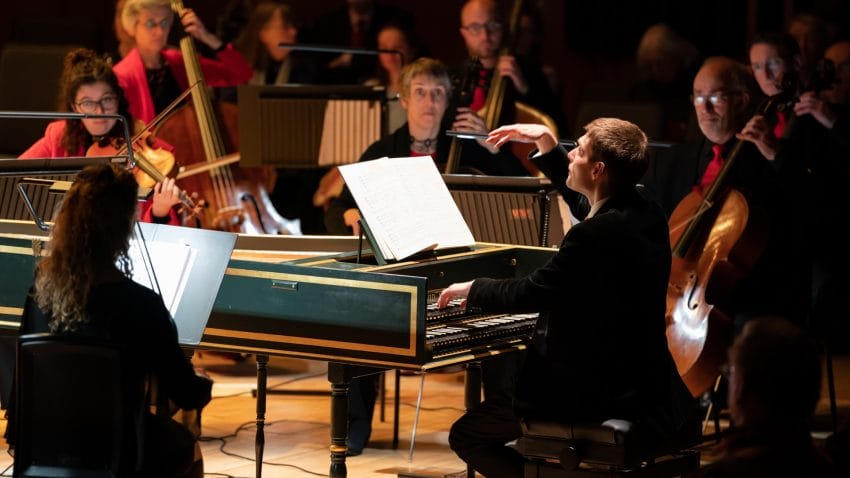
Claire Jones recording sessions

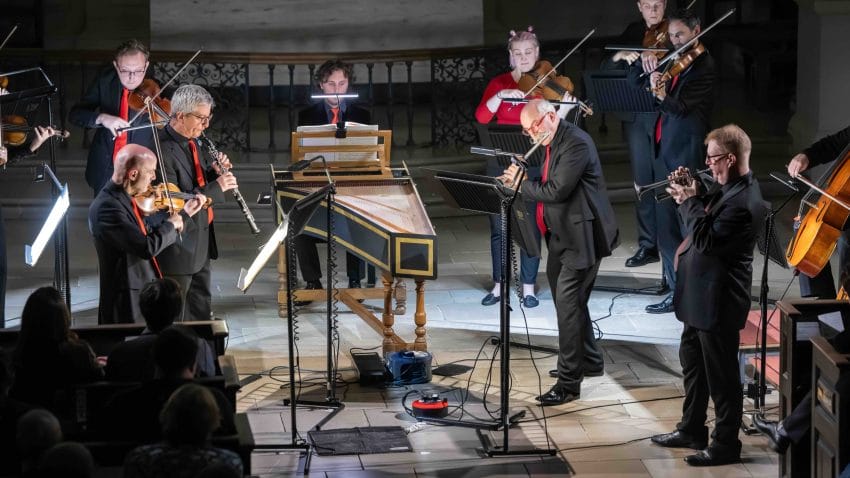
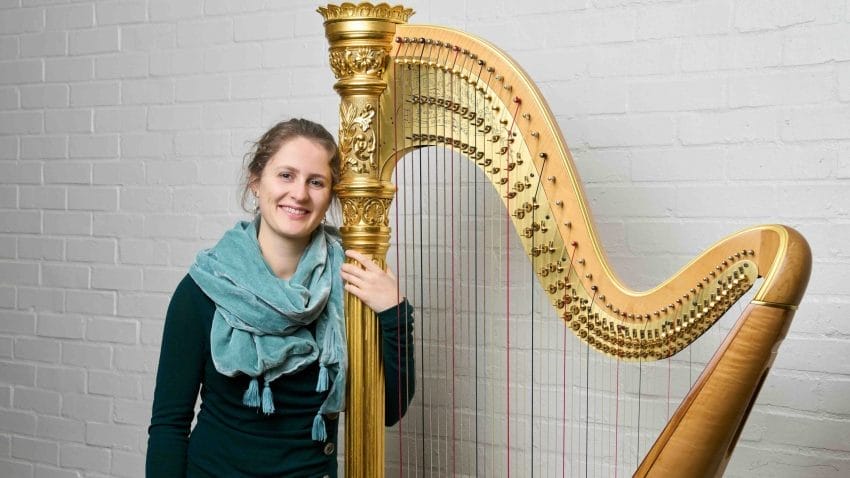
On Oct 22nd the LMP recorded a new album with Claire “The Girl With The Golden Harp”. The album is due to be released on March 1st. Please let us know if you would like to pre order a copy

Claire Jones (born in 1985) is a Welsh harpist who held the title of Official Harpist to the Prince of Wales from 2007 to 2011.

Jones was born in Crymych, Pembrokeshire, and began playing the harp at the age of 10; she performed for the Queen and Duke of Edinburgh when she was 16. In 2007, she was one of the inaugural winners of The Prince of Wales’s Advanced Study in Music Award, and was appointed as the prince’s official Harpist for a 3-year term. During the previous year, she had won the harp solo at the National Eisteddfod of Wales, been a finalist at the Third International Harp Contest in France, and won the Royal College of Music Harp Competition.

http://www.clairejones.co.uk

Connecting Generations: WW1 Songs Remembered and Shared

As part of a wide-reaching WW1 commemoration project, the London Mozart Players, Croydon’s resident orchestra, have been facilitating the visits of newly established primary school choirs to Croydon senior’s homes

.DSC_1830

As well as preparing Jonathan Dove’s new commission For an Unknown Soldier, the children of Atwood Primary Academy, Croydon Parish Church Juniors, Ecclesbourne Primary Academy and Monks Orchard Primary, have also been learning old wartime songs, and creating their own variations of them to sing to residents of local care homes. Repertoire includes Wish Me Luck, It’s a long way to Tipperary and other familiar tunes.

The choir of Monks Orchard Primary School performed at Elizabeth Court  on Wednesday 1st October, which also happened to be International Older People’s Day.

The ‘Coffee Concerts’ which have come to be known as WW1 Songs Remembered and Shared, are an important part of the project for several reasons. They are providing an important performance opportunity for the schools in the lead up to the main concert on the 14th November, and they are also encouraging the children to engage creatively with a bygone era.

DSC_1853

PRESS RELEASE: World Premieres of ‘For an Unknown Soldier’

The London Mozart Players and The Portsmouth Grammar School collaborate to commission major new cantata from Jonathan Dove to commemorate WWI

• World Première performances in Portsmouth and Croydon in November 2014
• Over 300 children from Portsmouth Grammar School and Croydon primary schools involved in the first performances
• Featuring renowned choral conductor Nicholas Cleobury and outstanding young tenor Nicholas Sharratt.

The London Mozart Players and The Portsmouth Grammar School will present the World Première performances of a major new co-commission from Jonathan Dove on 9 November 2014 in Portsmouth Cathedral and 14 November in Fairfield Halls Croydon. For an Unknown Soldier is a setting for tenor solo, children’s choir, adult chorus and chamber orchestra of nine poems about the First World War. Opening with a setting of Wilfred Owen’s portentous ‘1914’, the work offers a moving meditation on the tragedy of war with poems by Mary Gabrielle Collins, Helen Dircks and Ivor Gurney among others.

The LMP is delighted to continue what has become an annual collaboration with Portsmouth Grammar School, which has in recent years seen the commissioning of important new work from composers such as Roxanna Panufnik and Sir Peter Maxwell Davies.

James Priory, Headmaster of Portsmouth Grammar School comments:
“We are thrilled to be giving young musicians from Portsmouth and Croydon the opportunity to work with a living composer and to be involved in creating a major new musical work inspired by Remembrance. I cannot think of a better way for young people to engage creatively in the centenary of the Great War.”

Viv Davies, Managing Director of the London Mozart Players comments:
“We are really excited to be collaborating with the Portsmouth Grammar School and Jonathan Dove on such a significant and important project. The preparation for the events in November has brought together diverse individuals and groups in a unified and common purpose. We have no doubt that the première performances of the cantata will be profound and moving occasions that will express, in a wonderfully creative way, the essence, spirit and deep significance of remembrance. We are looking forward to it immensely.”

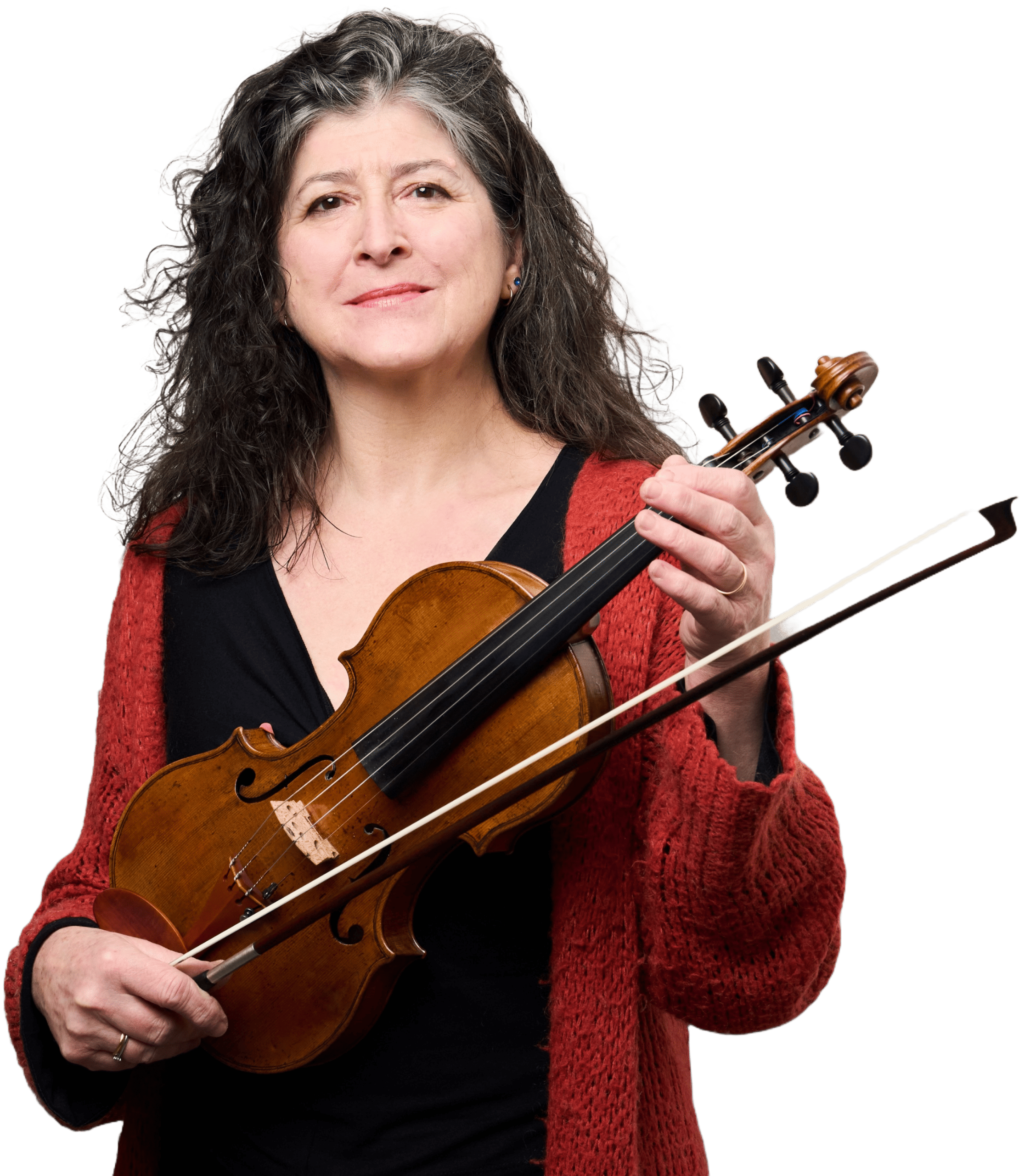
Simon Blendis – Leader

Simon Blendis joined the LMP as Leader in 2014. As well as leading for a wide variety of concerts, Simon has particularly enjoyed developing his relationship with the orchestra through an increasing amount of directing. He has also created the innovative leadership development event Podium, which has become an important strand of the LMP’s work and is gaining a strong reputation in the business world.

Away from the LMP Simon enjoys a varied career as a chamber musician, soloist and orchestra leader. He has been a member of the Schubert Ensemble for twenty-three years, with whom he has performed in over thirty different countries, made frequent broadcasts for BBC Radio 3 and appeared regularly at Europe’s major venues. After 35 years at the forefront of British chamber music the Ensemble will retire in 2018, leaving behind a legacy of over 80 commissions, 25 CD recordings and a large library of live performances on YouTube.

Simon is also in demand as a guest-leader and guest-director and has appeared in this role with most of the UK’s major orchestras. Since 1999 he has been one of the leaders of Orchestra Ensemble Kanazawa in Japan, with whom he has recorded Vivaldi’s Four Seasons for the Warner label. As a soloist he has made recent appearances with the Philharmonia Orchestra, the Academy of St. Martin-in-the-Fields, the RPO and the CBSO.

Simon is a keen exponent of new music. He has given over 50 first performances and has had new works written for him by, amongst others, John Woolrich, Tansy Davies and jazz legend Dave Brubeck, as well as violin concertos by David Knotts and Jeff Moore.
http://www.simonblendis.com/

Louise Honeyman – Recollections from Margaret Archibald

Personal Recollections of Louise Honeyman

The ‘phone rang. “Is that Margaret Archibald?” “Speaking.” “It’s Louise Honeyman; are you free on…” Just one more musician fixed for a date, but for me this was the beginning of a professional and personal relationship that was quite literally to change my life.

It was Louise who booked me near the start of my career for the Thames Chamber Orchestra and the English Symphony Orchestra, often playing for choral societies; it was Louise who seized on my enthusiasm for the C clarinet, asked if I was interested in authentic performance and launched me on my career as a period instrument player with my first date a Prom with the Academy of Ancient Music; it was Louise who helped me make the arrangements to have a babysitter with me on the flights and in the hotels when I took my four-and-a-half month old baby to Toulouse, Paris and Geneva; it was Louise who facilitated the arrangements when Lina Lalandi needed my seven year old son to be a Prince on stage for Gluck’s Alceste in Monaco; it was Louise who invited me to be sub- Principal clarinet of the London Mozart Players under Jane Glover and who told the wind players that she wanted us to form a wind chamber ensemble because she thought we deserved it. Finally, for me most life-changing of all, it was Louise who invited me to set up the “first year” of education and community work when the LMP became resident orchestra in Croydon, setting me on a course that saw me obsessively run the orchestra’s education work for the next 21 years.

Louise was more than just a fixer, she was a friend, a counsellor in times of trouble, always there to talk through a problem whether professional or personal. She would fight her corner but equally would listen to another point of view. She was a woman with a mission, and if this meant sacrificing a house and garden in north-west London for a tiny attic flat above the office in Croydon, this was something she cheerfully undertook to do in order to pursue her goal of fostering and building the London Mozart Players. Louise’s devotion to the orchestra was absolute, and she was always at every concert, sitting backstage busy with administrative tasks and ready to deal with any queries, comments, opinions or worries. I remember the anniversary of German re-unification when she bought the entire orchestra lunch in Dresden, following our morning concert there before we set out on another long coach journey to Leipzig for a concert that same evening in the Thomaskirche. On another occasion Louise chartered a plane to get us home from Lyons using an out-of-the-way military airfield somewhere for a late-night flight. She came with us on the ferry to Boulogne for the Menuhin Competition, and on the way home soothed the French customs officials who suffered a complete sense of humour failure when the mother of a young Japanese soloist took flash photos at the border post.

Memories of Louise are inextricably bound up with mental images of David, her partner, with whom she made common cause, building a vibrant community from a disparate group of freelance musicians and showing the way that an orchestra can be embedded in its local community through its outreach work. I was so lucky and honoured to be trusted by Louise to develop the LMP education and community work, and I threw all my personal creativity and energy at the project. At first I referred to Louise for every tiny decision until the day when she said, “Margaret, I haven’t got time to answer all these questions, just sort it out!” I went on “just sorting it out” for more than two decades and gained a wealth of experience, meeting many inspirational people in schools, nursing homes, hospitals, hospices, kids clubs, youth clubs and local authorities, and above all working with many wonderful colleagues who remain my very closest friends and with whom I continue to work now under the banner of my new charity Everyone Matters. Louise is a hard act to follow but I hope I can make even half the contribution that she did.

Margaret Archibald

Children learn about the war

LOOKING BACK: Children from Ecclebourne Primary School and music teacher Tim Sporerer with a log book from when pupils were evacuated from the school’s former buildings to make way for a war hospital. The book is on display at Croydon Museum”

Details of the Concert

Ecclesbourne School Museum visit 02

London Premiere – November 14

This event is expected to sell out. Tickets from £12.

Box office 020 8688 9291

Click here for more details

Click here to purchase tickets

The London Mozart Players are proud to announce their special concert at Fairfield Halls to mark the centenary of WW1 on Friday 14th November at 7.30pm.

This concert is the culmination of a far-reaching community project funded jointly by the Arts Council of Great Britain, Croydon Council and Portsmouth Grammar School.

The project has touched the community of Croydon on many levels with the formation of four junior school choirs performing alongside Whitgift School, Croydon Minster and Portsmouth Grammar School choirs in the London premiere of For an Unknown Solider written by the renowned composer Jonathan Dove.

Riddlesdown Collegiate will curate a WW1 commemoration exhibition to be displayed in the foyer on 14th November created from their trip to the First World War, Stories of Croydon exhibition at the Museum of Croydon, memorabilia collected from the residents of Croydon and their written responses to these artefacts.

All schools in Croydon have been invited to produce artwork to mark WW1 that will be displayed that evening in the Fairfield Halls.

We will be joined in the concert by young instrumentalists from Croydon Music and Arts who will play side by side with the LMP. Flautist Emma Halnan, the Croydon Festival winner 2013, will also perform a concerto with us.

We invite you all to join us with the community of Croydon to mark the WW1 Centenary.

Friday November 14th 2014, Fairfield Halls, Croydon at 7.30pm


LMP-WW1 leaflet emailLMP-WW1 leaflet email2


LMP Beijing May 2014

London Mozart Players: the ultimate comeback kids. Telegraph

Against all odds the London Mozart Players are still fighting fit, says Ivan Hewett. May 28th 2014

This week the London Mozart Players will prove that they really are the comeback kids of the orchestral world. Twice in recent years this fine chamber orchestra has threatened to disappear. The first time was in 2011, when it lost its Arts Council grant. The second was earlier this year, when Croydon Council pulled the plug on its very generous annual grant, after 24 years of support.

But it’s still with us, and on May 28 the LMP will be giving a concert with star guest soloist Angela Hewitt in St John’s Smith Square, repeated the following day at Fairfield Halls in Croydon.

The LMP has managed to pull back from the brink by practising what in America comes as second nature: self-help, and calling on a little help from friends. The orchestra has become a self-governing entity, with the players themselves acting as the orchestra’s agent, manager and PR. A few months back Vernon Ellis, chairman of the British Council and patron of English National Opera, hosted a fund-raising concert for the orchestra at his house. That and some energetic proselytising by the players has raised just under £100,000. A number of eminent musicians associated with the orchestra have given their services for free, including pianist Howard Shelley, conductor Hilary Davan Wetton, violinist Tasmin Little, and the winner of the BBC Young Musician of the Year in 2012, cellist Laura van der Heijden. These two concerts this week are a way of saying we’re still here and we mean business.

I’m glad they’re still here, because for me and many other classical music lovers the LMP is part of this country’s musical furniture. The orchestra was founded in 1949, which makes it the oldest chamber orchestra in Britain, and was led right up to the early 1980s by its founder Harry Blech. I saw him as a student in the latter part of his reign, and remember thinking he seemed as old as the hills. He strode stiffly up to the podium and conducted with a no-nonsense sturdy technique, as if he was kneading dough.

Since then Jane Glover, Matthias Bamert and Andrew Parrott have all taken on the role of MD. I remember the Bamert years especially well, as the orchestra’s programming was particularly lively, with a steady flow of commissioned works. Since 2010 the gifted South African-born conductor Gerard Korsten, whom the players clearly warm to, has taken the lead.

So what next? There are several steps the Players are taking to survive in the medium term, such as reviving their connection with Croydon’s Fairfield Halls. This has the best acoustics in Greater London, and the orchestra has a history of residency there stretching back 24 years. The orchestra also has a long-standing relationship with Portsmouth Grammar School, which has involved commissiong a string of new works, and also burgeoned outwards into the local community. There are plans to transplant the fruits of this back into the orchestra’s original Croydon base.

This combination of artistic enterprise with grass-roots involvement gives a model of how the orchestra might prosper in the long term. Bringing this off won’t be easy. Like the Academy of St Martin-in-the-Fields, the LMP has had some of its shine taken off by the rise of “period” bands such as the Orchestra of the Age of Enlightenment. At the other end of the historical spectrum are those groups which have pulled the chamber orchestra into the modern era, such as the Britten Sinfonia and the Scottish Ensemble.

The signs are that the LMP is learning a few tricks from these upstarts. There are plans to build relationships with starry musicians to act as soloists and directors for particular projects, as the Britten Sinfonia does so cleverly. There’s also a sense among these younger orchestras that rooting what they do in a particular place and time is the key to success, as much as artistic quality. For example, rather than just commissioning a composer to write a piece, you link it to something specific about the moment. The LMP has tried this already with its Portsmouth commissions, where each year the new piece has been linked to the theme of Remembrance Day (a particularly emotive topic in a naval city).

This shows the LMP is serious about reinventing itself. On the other hand, there is the accumulated loyalty and affection, among both audiences and musicians, for what the LMP has always been. And of course there’s the inherited treasure of the orchestra’s core repertoire. Mozart and Haydn’s symphonies and concertos will always be great music, and there will always be an appetite for them.

The difficulty is that these different aspects of the orchestra’s identity pull in different directions. The trick over the coming months and years will be to manage that tension, so that past and present knit together in a way that makes sense. It’s a more than worthy enterprise, and we should wish them well with it.

David Angel

20th July 1954 – 10th April 2017

David Angel studied at the Yehudi Menuhin School with Frederick Grinke and Jaqueline Salomons, and had many masterclasses with Lord Menuhin.

In 1971 he won an Associated Board Scholarship to study at the Royal Academy of Music with Frederick Grinke. He had regular chamber music coaching with Sidney Griller and won prizes for both solo and chamber music.

He has played quartets professionally since 1976; for eleven years with the Bochmann Quartet and since 1988, with the Maggini Quartet, which he co founded in that year. With the Quartet he has performed and broadcast widely as well as recording some thirty discs and working with composers such as James McMillan, Eleanor Alberga, Roxanna Panufnik, and extensively with Sir Peter Maxwell Davies.

With pianist David Elwin he has enjoyed a long standing duo: in September 2007 they made their maiden tour of Japan.

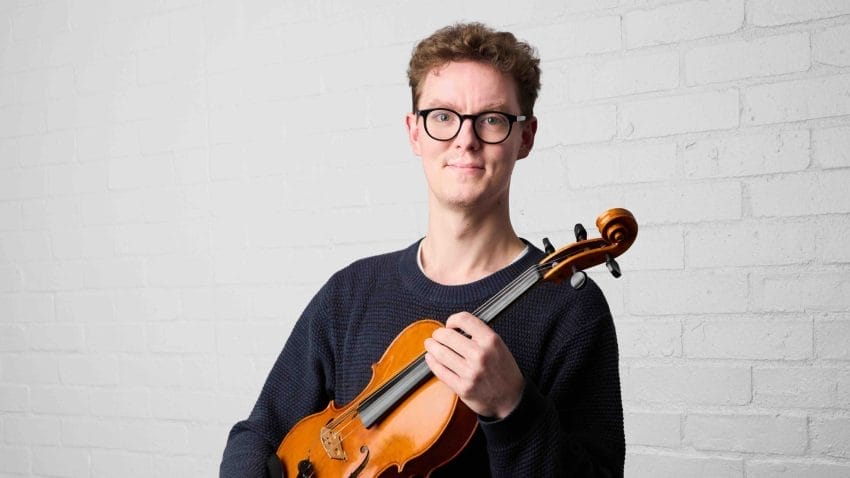
When his quartet schedule allows, he co-leads the 2nd violins of the London Mozart Players, a job he has held since 1995.

Much in demand as a teacher and quartet coach, he has been professor of quartet playing at the Birmingham Conservatoire since 1993. In addition to teaching privately, he has taught violin at Southampton University, the Birmingham Conservatoire, and as a guest at the Menuhin and Purcell schools.

Judith Busbridge

Judith graduated in Music from Birmingham University and completed her viola studies with Thomas Riebl in Salzburg, where she was solo violist in the Camerata Academica under the directorship of Sándor Végh, a post she held for 5 years.

Outside her schedule with London Mozart Players she was, until 2011, a founder member of the multi-award-winning Dante String Quartet, with whom she performed at major concert halls and festivals throughout the UK and Europe, winning the prestigious Royal Philharmonic Society Award for Chamber Music in 2007.
From 2010-13 she was violist with Ensemble 360, a versatile group of eleven musicians of international standing who enjoy a residency in Sheffield with Music in the Round, and with whom she again won the RPS Award for chamber music in 2013.

Judith’s varied freelance career also includes playing guest principal viola with the English Chamber Orchestra, the Philharmonia Orchestra, Royal Opera House, City of Birmingham Symphony Orchestra and The Academy of St Martin in the Fields. She is also solo viola in John Eliot Gardiner’s Orchestre Révolutionnaire et Romantique, which performs repertoire of nineteenth and early twentieth centuries on period instruments.

Since September 2013 she is also one of the principal violas with the Orchestra of the Royal Opera House, Covent Garden.

Sarah Burnett

When did you join the LMP?

2010

Where else do you work?

I’m a member of Britten Sinfonia, The Haffner Wind Ensemble and teach at the Royal College of Music. I am also Bassoon Consultant at the Royal Birmingham Conservatoire..  Any free time after that takes me up and down the country, working for other orchestras as guest principal, as well as giving masterclasses and doing the odd bit of session work.

When did you start playing the bassoon?

Aged 11

What is your first musical memory?

Playing for the first time ever in an orchestra.  It was Shostakovich’s 5th Symphony with the National Youth Orchestra.  I was only 12 and was totally overwhelmed by the sheer raw power of the music.
What is special about your instument?

It’s an old 1927 Heckel with a huge history, and it happens to have been made the same year as my house was built.  It has a warm singing voice with many individual quirks, which always makes it interesting to play. Shostakovich said the bassoon was the instrument closest to the human voice; I don’t think you can get a better compliment than that.

What do you do in your spare time?

I love being outdoors, whether it’s just pottering in the garden, going for walks and cycles or having a barbeque.  Friends and family are extremely important to me; there’s nothing better than sharing food and wine with those you love.


Michael Posner

Michael studied with Nobuko Imai, Mischa Geller and Simon Rowland-Jones at the Royal Northern College of Music, where he achieved a Gmus RNCM and PP RNCM, and was the winner of the Dearden Academic Award.

Upon leaving the RNCM, he joined the Peterborough String Orchestra where he became principal viola, playing regularly in the Chamber Ensemble and as soloist with the orchestra. Michael then moved to London, where he became a member of the London Mozart Players and a regular in all of London’s leading chamber orchestras including the Academy of St Martins, English Chamber Orchestra, City of London Sinfonia and Britten Sinfonia. He has toured and recorded extensively with these orchestras.

Over the last 20 years Michael has developed a passion for teaching, alongside his playing. He held a post at Trinity College of Music, Junior Department for 14 years, and has recently taken up a post at Bromley Youth Music Trust teaching violin and viola, coaching chamber music and conducting orchestras. With his wife Julia Desbruslais, he runs the highly successful Summer Strings music courses, and coaches regularly on the Arpeggione course.
Michael is a keen supporter of Arsenal football club.

Julia Desbruslais

At sixteen Julia Desbruslais won an open scholarship to study the cello with Florence Hooton at the Royal Academy of Music.  During this time she won many awards including the Suggia Award and the Leverhulme Chamber Music Scholarship.  Under the direction of Sydney Griller she was a founder member of the all-female Fairfield String Quartet. They enjoyed ten years touring Britain and Europe, winning major competitions, giving many live broadcasts for the BBC, and recording for Hyperion.

On leaving the Quartet, she became Co-Principal Cello with the London Mozart Players, where she regularly performs with the Chamber Ensemble and has appeared as a concerto soloist. She is also Principal Cello with the London Jupiter Orchestra, with whom she has performed John Taverner’s Eternal Memory at St John’s, Smith Square. She regularly plays as guest principal with many London orchestras, including the New London Orchestra and City of London Sinfonia.

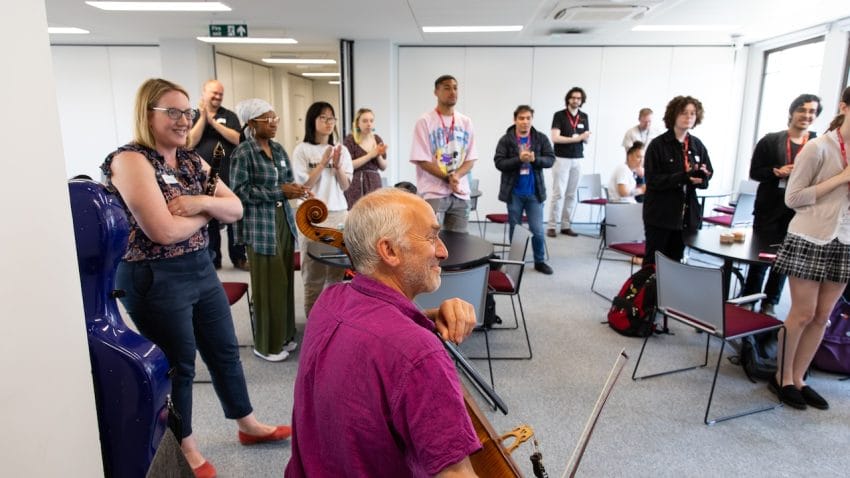
She has a great passion for inspiring young children and is one of the leading lights in the vast education programme of the LMP. Her work has included performing to all ages from work with young children to the elderly in numerous and varied venues.  Her work with young children led to the production of television workshops and compositional projects and she was responsible for the setting up of cello master classes and massed cello ensembles with young children. Julia holds posts as a cello teacher at Whitgift School and Eltham College, and a large private class. With her husband Michael Posner, they run the highly successful Summer Strings residential music courses for children of all ages.

She is a member of the cello quartet formed from the four cellists of the LMP, presenting concerts drawing on the works of the great cellist composers. Their first CD Petits Fours was received with great acclaim. Recent recordings include ‘Lullaby for a Lost Soul’ by Ronald Corp.

Sarah Butcher – Cello

Sarah studied cello with Stefan Popov at the Guildhall School of Music and chamber music with Hans Keller and the Chilingirian String Quartet. She also took part in masterclasses with William Pleeth at the Aldeburgh Summer School. She has played in many orchestras and ensembles in the UK including the BBC Symphony orchestra, The Guildhall String Ensemble, the Orchestra of the Age of Enlightenment, Peter Gabriel’s New Blood Orchestra, English Touring Opera, Garsington Opera and Glyndebourne Touring Opera Orchestra for whom she has played principal cello.

She has made recordings for the Cello Classics label, Music for Two Cellos and ‘Petits Fours’, music for four cellos with the London Mozart Players cello section. Also on the Cello Classics label she has performed in a CD of music by the great pedagogue Julius Klengel. As a baroque cellist and founder of Bach Camerata she has also recorded St John Passion (in English) with The Crouch End Festival Chorus and David Temple.

Sarah is a keen chamber musician and has played with the Mistry String Quartet and was a member of the Mainardi Trio. For 10 years she was Artistic Director of The Chamber Players who play regularly at Festivals and venues throughout the UK, including Holywell Music Rooms, Imperial College and Buxton and Chichester Festivals with artists such as Ashley Wass, Gaby Lester, Tim Horton and Benjamin Nabarro.

Sarah is a keen participant in education and community projects and plays principal cello in the Chipping Campden Festival Academy Orchestra, sitting side-by-side with music college students for a series of concerts in the Chipping Campden Festival. Other recent projects include devising a piece for the Croydonites Festival with SLiDE in South Norwood and workshops and concerts for Everyone Matters in Bromley and Kingston.

Sarah also edits audiobooks for the Naxos AudioBooks label and has been involved in many exciting projects including The History of Classical Music and Famous Composers in collaboration with ClassicFM. She has performed on several of these discs including The Cellist of Sarajevo and Macbeth with music by oscar-winning composer Stephen Warbeck.

She has been a member of the London Mozart Players since 1998.

Louise Honeyman R.I.P.

Louise Honeyman died on March 19th 2014. Louise was the Managing Director of the LMP during the 80’s and 90’s. She was the first Woman MD of a British Orchestra. Jane Glover was appointed, by Louise, as Artistic Director. In March 1989 she approached Croydon Council and they agreed to make the LMP their resident orchestra. Louise was also responsible for bringing in HRH Prince Edward as the Patron.

Louise was a much loved character and the LMP was her passion right through her retirement. She suffered a severe Stroke on March 15th 2014. Her partner was David Wilson who has been the General Manager of the orchestra since the 80’s. David bravely attended our concert on March 20th accompanied by Louise’s family.

We will all miss Louise tremendously. The concert on March 20th was dedicated to her memory. Our thoughts are with David and Louise’s family.

Press Release February 12th 2014

PRESS RELEASE: 12 February 2014

“A renaissance for the London Mozart Players!”

‘’……….it gives me more joy than I can say to perform and record with them, I am honoured to be their Conductor Laureate” (Howard Shelley)

The London Mozart Players, the UK’s longest established chamber orchestra and considered by many as one of Europe’s finest, is to become self-governing in a bold but characteristically creative move to counter recent funding cuts.

As of May 2014, when the LMP’s current principal conductor, Gérard Korsten, rests the baton at the final concert in their 2013/14 Fairfield Halls series, a core group of orchestral members led by Viv Davies, a former classical musician turned economist with 20 years senior management experience in the non-profit sector, will take up collective responsibility for the management and strategic direction of the orchestra, drawing upon a wealth of professional experience from within the ranks of the LMP.

Current members of the management team include Paul Archibald (Projects), Julia Desbruslais (Education) and Peter Wright (Operations). David Wilson (General Manager), Jenny Brady (Concerts Coordinator) and Martin Sargeson (Orchestral Librarian) will continue to provide crucial administrative, management and logistical support.

In support of the management team will be an impressive and experienced group of player ambassadors, led by Marieke Blankestijn, that will advise on the artistic direction of the LMP.

The LMP’s niche lies in interpretive research and understanding of performance style, but with the advantages of instruments designed for the modern concert hall and audience. Its mission is to perform classical music to the highest standards of excellence and to take music to communities where access to live concerts is limited. The orchestra is also committed to devising workshops for schools and hospitals, creating projects that bring people together and enrich lives through a shared musical experience. New plans and initiatives are now underway as the LMP is set to build exciting new partnerships within these communities.

There is unanimous commitment to ensuring the LMP will continue to occupy an exciting and dynamic position in the musical life of the UK and on the international stage. One of the LMP’s first engagements as a rejuvenated organisation will be a tour of China in May. In the meantime, a gala fundraising concert featuring Howard ShelleyTasmin Little and Laura Van der Heijden will take place on 29 April in Kensington. Discussions are also underway with sponsors for concerts through 2014/15, and for a range of community-based projects in the south-east and around the UK.

This orchestra is one of the jewels in the crown of British music.”(Hilary Davan Wetton)


For further information on the LMP and its activities please contact:

Paul Archibald: 07973 731866, [email protected]

Peter Wright: 07831 157618, [email protected]


ENDS


PRS for music foundation confirms funding support for LMP

Jonathan Dove, one of the UK’s top contemporary composers, and winner of an Ivor Novello Award, will be writing a new cantata to be performed by the London Mozart Players as part of Croydon’s First World War Centenary commemorations next year. Read more

Christopher O’Neal (interview)

Read more